procedures commodities

  1. Quote is prepared by SOTO FILHOS EXPORT as seller mandate or representitive and given to buyer

  2. The buyer issues a letter of Intent (LOI) + NCND + IMFPA with the soft probe authorization duly signed/or a Bank Comfort Letter (BCL) or RWA  from their bank.

  3. SOTO FILHOS EXPORT on behalf of the supplier, then send a Final Contract Offer (FCO) to buyer, confirming that LOI has been accepted and detailing the pricing, procedure and specifications of the product. This needs to be signed by the buyer and returned via fax/email to SOTO FILHOS EXPORT

  4. The supplier issues a Draft Contract to the buyer for comments and acceptance. The buyer signs and returns the draft contract to SOTO FILHOS EXPORT via fax and email, showing all amendments required and adds full banking coordinates as set out within SOTO FILHOS EXPORT checks and forwards to the supplier, if all changes are deemed acceptable.

  5. An Amended Draft Contract is sent to the buyer, for signing, and then faxed to SOTO FILHOS EXPORT who will forward to the supplier. The signed Amended Draft Contract shall be deemed legal until final contract hard copies are exchanged. This shall not delay the buyer from establishing the payment instrument in the seller's account.

  6. The supplier sends the Proof of Product (POP) against the Proof of Funds (POF) (the draft LC letter provided by buyer's bank). Within FIVE (5) banking days after the Amended Draft Contracts, signature, the buyer opens a financial instrument in their own bank and then provides the supplier Non-Operative Letter of Credit for approval and then forwards it to the supplier's bank.

  7. The supplier amends where necessary the Hard Copy Contract, signs, seals and issues to the buyer for his completion, the buyer signs the hard copy contract and returns it to the supplier via DHL. Any facsimile copy shall be considered as the original. The Buyer shall return with the signed and sealed contract a full page copy of their passport.

  8. Within TEN (10) banking days after the receipt and confirmation of a letter of credit acceptable to the supplier the supplier then issues a fully active two percent (2%) Performance Bond of the letter of credit value, at which time the buyer's Letter of Credit becomes Fully Active and Operative.

  9. Delivery and shipment commence as per the terms and conditions of the contract.

  10. The first shipment will commence no later than THIRTY-FIVE (35) days from date of issue of the operative Letter of Credit. The remaining consignments will be affected in each 30-45 days periods after the acceptable operative L/C at seller's bank.

  11. IMPORTANT - ANY PROCEDURES CAN CHANGE OF AGREE WITH SELLER OR PRODUCT

procedures  - PETROLEUM PRODUCTS 

1. BUYERS SEND ICPO WITH SOFT PROBE + NCND + IMFPA
2. Seller’s SEND FCO with acceptance letter including buyer’s bank details, cooperate license with company       profile and/or passport number as identification.
3. Seller issues notarized attestation by state ministry of justice/independent chamber of commerce confirming     availability of product to be allocated to buyer
4. The Buyer issues letter endorsed by Buyer’s bank confirming with full responsibility that Buyers Bank will         swift RDLC/MT103 immediately after POP is verification of  all documents and certificates .
5. The Seller issues letter endorsed by Seller’s bank confirming with full responsibility that Seller’s Bank will         swift 2% performance guaranty immediately after Buyers Bank swift RDLC/MT103
6. IMFPA to be issued by Seller to be signed and endorsed by buyer and buyer’s Full Power Mandate
7. Seller sends Contract to be evaluated and signed by Buyer. Original Hard copies issued and exchanged by       courier to be sent to all party’s office address within a week of signatory.
6. Ownership and titles of the product are transferred to the Buyer simultaneously after all amendements / all       Russian ministrial and agency re-registration by buyer. Transaction passport  to be issued  to buyer directly     by seller’s bank.
7. Sellers Bank swift POP and Tank Storage Numbers including all relevant documents and certificates to             Buyers Bank for verification.
8. Seller shall send by e-mail to Full Power Mandate through his representative scanned copy of the swift in         maximum two (2) hours after original was sent by Sellers Bank.
9. Buyers’ Bank verifies authenticity of documents and if confirmed and accepted buyer’s bank swifts                   RDLC/T103  to Sellers Bank.
10. Buyer’s Bank releases payment to a. Sellers  Bank and to be   re-redirected to all Paymasters Bank               accounts  simultaneously by a. SWIFT RDLC/MT103
11. Seller’s bank issue 2% performance guaranty to activate buyer’s payment instrument.
Posted by Juan soto on november 11, 2008 Comments (01)

letter of credit - informations 

In simple terms, a L/C is an undertaking by a bank to make a payment to a named beneficiary within a specified time, against the presentation of documents which comply strictly with the terms of L/C.

Its main advantage is providing security to both exporter and the importer, but the security offered, however, comes at a price and must be weighed against the additional costs resulting from bank charges. The exporter must understand the conditional nature of the letter of credit and the fact that payment will not be made unless the terms of the credit are met precisely.

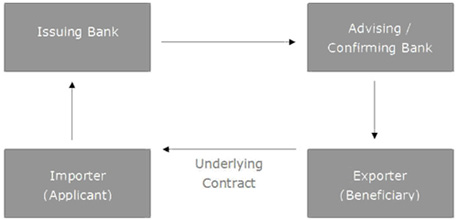
A letter of credit is opened by an importer (applicant), to ensure that the documentation requested reflects and proves that the seller has performed under the requirements of the underlying sales contract, by the exporter by making them conditions of the letter of credit (N.B. The sales contract is not an inherent part of the Letter of Credit, although the Letter of Credit may contain a reference to such contract). For the exporter a letter of credit, apart from cash in advance, is the most secure method of payment in international trade as long as the terms of the credit are met. The following diagram shows those involved in a Letter of Credit transaction:

lc

When an exporter asks for payment by letter of credit, he is transferring the risk of non-payment by the buyer to the issuing bank (and the confirming bank if the letter of credit is confirmed), providing the exporter presents the required documents in strict compliance with the credit.

An importer should only be thinking of opening a letter of credit if his country's exchange control regulations require it or if his supplier insists upon it. It is worth noting that over 50% of letters of credit are rejected on first presentation, which can cause expensive delays for both the exporter and importer. Up to one half of these rejections could have been avoided if more care was taken to ensure the credit properly represented the sales contract.

Exporters are necessary to use L/C Typical considerations include:

Is it a legal requirement in the importing country?

What is the value of the order – will the bank charges be out of proportion to the value?

“Always traded this way” – always using letters of credit for a particular customer or region without periodically re-assessing the reasons for requesting this method of payment

What is the credit rating of the importer and are they a new customer or has a trading relationship already been established?

What is the country risk of the importing country (would a confirmed letter of credit be more suitable)?

What is the standing of the issuing bank (Would a confirmed letter of redit be more suitable)?

What is the usual practice in trading with that country and in that particular commodity?

Are there any other measures that could be taken to protect the exporter (e.g. credit insurance)?

Insistence by a Credit Insurer to trade on letter of credit terms with buyers in certain markets.

Recommendation by banks who may advise that the best method of payment is a 'confirmed irrevocable letter of credit' irrespective of the country, strength of issuing bank and without much regard to the value of the consignment.

Strategic Decision Made by the Exporter – however, this strategy should be flexible to adapt to the changing risk profile of both the country and the buyer..

f the issuing bank or the buyer fails to make payment. The added security to the exporter of confirmation needs to be considered in the context of the standing of the issuing bank and the current political and economic state of the importer's country. A bank will make an additional charge for confirming a letter of credit.

Confirmation costs will vary according to the country involved, but for many countries considered a high risk will be between 2%-8%. There also may be countries issuing letter of credit which banks do not wish to confirm – they may already have enough exposure in that market or not wish to expose themselves to that particular risk at all.

type letter of credit


IRREVOCABLE
An irrevocable letter of credit can neither be amended nor cancelled without the agreement of all parties to the credit. Under UCP500 all letter of credit are deemed to be irrevocable unless otherwise stated. Here, the importer's bank gives a binding undertaking to the supplier provided all the terms and conditions of the credit are fulfilled.

UNCONFIRMED
An unconfirmed letter of credit is forwarded by the advising bank directly to the exporter without adding its own undertaking to make payment or accept responsibility for payment at a future date, but confirming its authenticity.

CONFIRMED
A confirmed letter of credit is one in which the advising bank, on the instructions of the issuing bank, has added a confirmation that payment will be made as long as compliant documents are presented. This commitment holds even i

STANDBY LETTER OF CREDIT
A standby letter of credit is used as support where an alternative, less secure, method of payment has been agreed. They are also used in the United States of America in place of bank guarantees. Should the exporter fail to receive payment from the importer he may claim under the standby letter of credit. Certain documents are likely to be required to obtain payment including: the standby letter of credit itself; a sight draft for the amount due; a copy of the unpaid invoice; proof of dispatch and a signed declaration from the beneficiary stating that payment has not been received by the due date and therefore reimbursement is claimed by letter of credit. The International Chamber of Commerce publishes rules for operating standby letter of credit – ISP98 International Standby Practices.

REVOLVING LETTER OF CREDIT
The revolving credit is used for regular shipments of the same commodity to the same importer. It can revolve in relation to time or value. If the credit is time revolving once utilized it is re-instated for further regular shipments until the credit is fully drawn. If the credit revolves in relation to value once utilized and paid the value can be reinstated for further drawings. The credit must state that it is a revolving letter of credit and it may revolve either automatically or subject to certain provisions. Revolving letters of credit are useful to avoid the need for repetitious arrangements for opening or amending letters of credit.

TRANSFERABLE LETTER OF CREDIT
A transferable letter of credit is one in which the exporter has the right to request the paying, or negotiating bank to make either part, or all, of the credit value available to one or more third parties. This type of credit is useful for those acting as middlemen especially where there is a need to finance purchases from third party suppliers.

BACK-TO-BACK LETTER OF CREDIT
A back-to-back letter of credit can be used as an alternative to the transferable letter of credit. Rather than transferring the original letter of credit to the supplier, once the letter of credit is received by the exporter from the opening bank, that letter of credit is used as security to establish a second letter of credit drawn on the exporter in favor of his importer. Many banks are reluctant to issue back-to-back letters of credit due to the level of risk to which they are exposed, whereas a transferable credit will not expose them to higher risk than under the original credit.

UNIFORM CUSTOMS AND PRACTICE FOR DOCUMENTARY CREDITS (UCP)
Most letters of credit are subject to UCP 500, which are the universally recognized set of rules governing the use of the documentary credits, in international trade. UCP were originally formulated in 1933 by the  International Chamber of Commerce (ICC) and last updated in 1993 (ICC publication 500). All definitions and general documentary requirements referred to in this briefing are in accordance with UCP500 unless otherwise stated (it should be remembered that in some instances this may differ from national law). FSAP Ltd. HK would only recommend using letters of credit which are subject to UCP500.

logo


  .